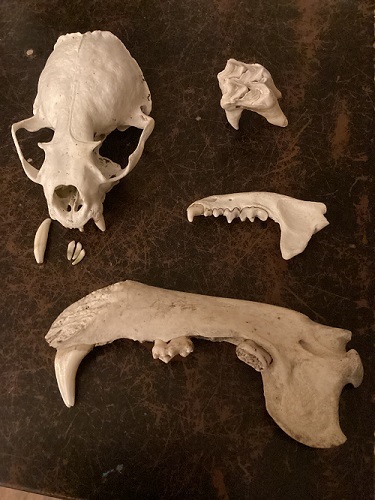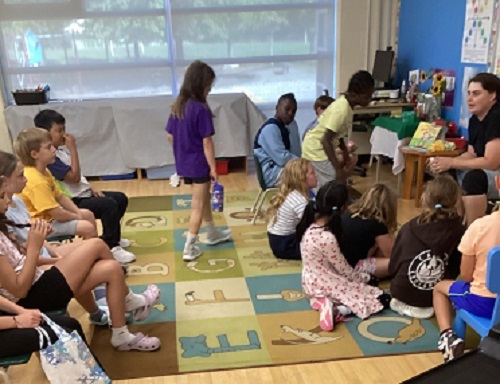
This month in School Age 3, we started off the year with some biology! Educator Dean brought in several animal specimens including a river otter skull, jaw bones from a lynx and a racoon, a moose tooth, a flame knee tarantula molt, a pinned owl butterfly, and a dead scorpion – along with the stories of how each of the bone specimens were found. This sparked several in depth conversations about why the animals are built the way they are, similarities and differences between our own bone and tooth structure and that of the animals, and the habits and behaviours each animal displays both in nature and in captivity. We also talked about how human presence and infrastructure led to the deaths of several of these animals as all the bone specimens were found along the CN railway tracks.
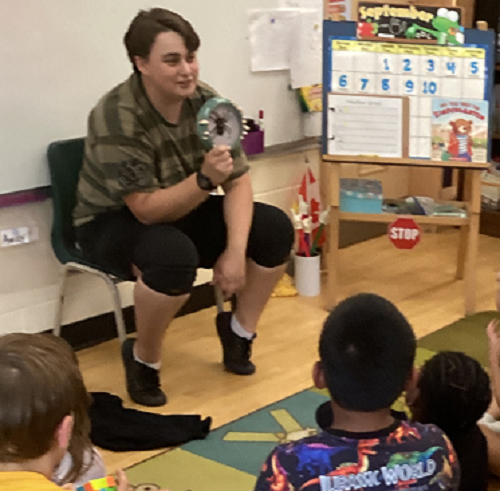
With the river otter skull, one of the first things the children noticed was the length of the teeth, as the lack of flesh allowed the teeth to slide out of the skull, revealing the ¾” roots. They also observed that the moose tooth looked like their molars. This sparked a conversation about how herbivores have flatter teeth for grinding down leaves and foliage, and carnivores have sharper teeth for ripping meat and flesh off carcasses. One child observed that we have both types of teeth, and concluded that this is because humans can eat both meat and vegetation.
Upon learning that the tarantula was actually just the skin, and its previous occupant in currently very much alive in a terrarium in Cambridge, Ariana pointed out that they were just like snakes, shedding as they grow instead of their skin stretching and growing like ours. Aaron added that unlike snakes, spiders shed their skin upside down.
The following week, Educator Ali brought in a preserved mouse. This was different from the animals we explored earlier as we looked at only parts of animals, this was a full mouse. Some friends were excited to see it, wanting to know why it was in water. We learned that it was not in water, but actually a chemical used for centuries to preserve bodies called formaldehyde! We also learned that this is a known irritant so after touching the glass we washed our hands very well, for extra safety. There were many things we learned about this mouse, and the children were shocked at how small it was despite it being fully grown. Tanisha asked how we knew it was a girl, which turned to a discussion about how some animals can easily be identified as a certain gender by how its body is built - male mice look a lot longer! Later on we have also introduced fossils, species that may not be around anymore as well as kinds of animals that we can still find around the water even to this day! September has been such a great month for natural exploration of the world around us.